
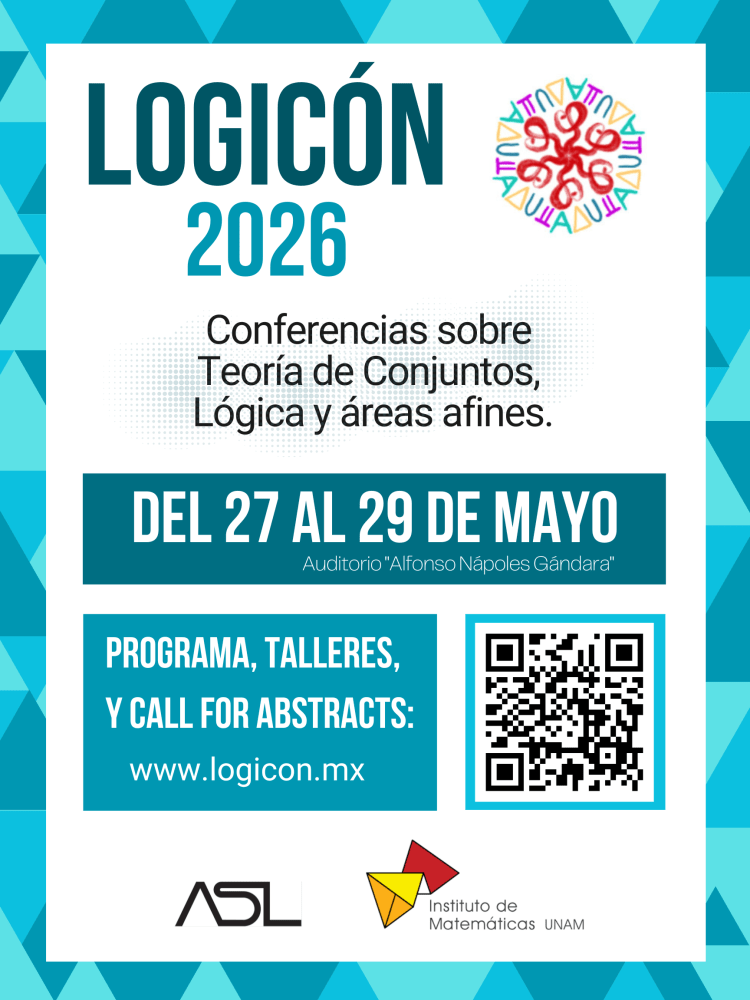
Thursday May 27th to Friday May 29th, 2026
“Alfonso Nápoles Gándara” Auditorium, Institute of Mathematics
UNAM, México City
Registration at the auditorium’s entrance. For questions and/or comments: logiconmx@gmail.com
Call for abstracts
If you are interested in presenting your work, you can send your abstract and information via the following form: https://forms.gle/mQ6iRbv6qnc6vPQ17.
Around 8 to 12 proposals will be accepted, with the possibility of travel and lodging funding subject to availability.
Deadline: February 27th, 2026.
In order to help us better allocate funds, please send your submission by the start of the week of February 23rd.
Speakers
Dr. Atocha Aliseda Llera, IFF UNAM.
Dr. Cristian Alejandro Gutiérrez Ramírez, FFYL UNAM.
Dr. David Gonzalez, Notre Dame.
Dr. David José Fernández Bretón, ESFM IPN.
Dr. Francisco Marmolejo, IM-CU UNAM.
M. Henry Klatt, GWU.
Dr. Jorge Antonio Cruz Chapital, UToronto.
Dr. Leonardo Nagami Coregliano, UChicago.
Dr. Mariana Vicaria, UChicago.
Dr. Omar Antolín Camarena, IM-CU UNAM.
Dr. Rachael Alvir, UWaterloo.
Program
Wednesday 27
| 10:00 Dr. Jorge Antonio Cruz Chapital (50 min) |
| 11:00 Dr. David José Fernández Bretón (40 min) |
| 11:50 Submitted talk I (40 min) |
| 12:40 Submitted talk II (40 min) |
| 13:20 Lunch |
| 14:30 Dr. Atocha Aliseda Llera (50 min) |
| 15:30 Invited speaker (40 min) |
| 16:20 Submitted talk III (40 min) |
| 17:10 Invited speaker (40 min) |
Thursday 28
| 10:00 Dr. Francisco Marmolejo (50 min) |
| 11:00 Panel: Enseñanza de la Lógica. Moderator: Dr. Cristian Alejandro Gutiérrez Ramírez (1hr 20min) |
| 12:40 Submitted talk I (40 min) |
| 13:20 Lunch |
| 14:30 Tutorial: Dr. Olga Medrano Martín del Campo (50 min) |
| 15:30 Invited speaker (40 min) |
| 16:20 Submitted talk II (40 min) |
| 17:10 Tutorial (50 min) |
Friday 29
| 10:00 Dr. David Gonzalez (English, 50 min) |
| 11:00 Dr. Rachael Alvir (Zoom, English, 40 min) |
| 11:50 Submitted talk I (40 min) |
| 12:40 Submitted talk II (40 min) |
| 13:20 Lunch |
| 14:30 Plenary (50 min) |
| 15:30 Henry Klatt (English, 40 min) |
| 16:20 Submitted talk III (40 min) |
| 17:10 Tutorial (50 min) |
Abstracts
Wednesday 27
11:00-10:40
Dr. David José Fernández Bretón, ESFM IPN.
“¿Qué podemos demostrar?, y ¿Qué tan grande es el infinito? Una y la misma pregunta…”
Entrentre las varias ramas de la lógica y la teoría de conjuntos, se encuentran dos que destacaremos: por un lado, el estudio acerca de aquello que es demostrable por medio de axiomas dados (como continuación de la línea de pensamiento iniciada por Hilbert e impulsada por Gödel); por otro, el estudio formal acerca de las propiedades combinatorias del infinito (descendiente directo de las indagaciones de Cantor de finales del siglo XIX). Un fenómeno muy interesante es cómo estos dos aspectos se encuentran estrechamente entrelazados: en varios casos se ha detectado que el conjunto de enunciados demostrables desde ciertos axiomas es, en un sentido técnico fuerte, más grande entre más grandes sean los tamaños del infinito que postulamos que existen. En esta plática procuraremos proporcionar algunos ejemplos históricos de este fenómeno, tanto en los niveles “bajos” de infinitud (resultados de Gentzen, Paris–Kirby, etc.) como también en los niveles más “altos” (cardinales fuertemente inaccesibles, medibles, etc.).
14:30-15:20
Dr. Atocha Aliseda Llera, IFF UNAM.
“Hacia una IA Neurosimbólica”
En esta charla presentaré prmero dos paradigmas de la IA. El primero de ellos — la IA simbólica – tiene a la lógica matemática como herramienta por excelencia. El segundo paradigma cuenta con una arquitectura de red (neuronal) y le subyacen métodos estocásticos. Si bien estos últimos han sido muy exitosos en algunos dominios, no cuentan con métodos seguros de verificación formal. ¿Es deseable usar ambos métodos? Discutiré la pertinencia de abrir la puerta a modelos híbridos en donde tanto la especificación formal como los procesos escolásticos tienen lugar.
Friday 29
10:00-10:50
Dr. David Gonzalez, Notre Dame.
“A Scott Analytic Perspective on Vaught’s Conjecture”
Robert Vaught conjectured that the number of countable models of any first-order theory must be either countable or continuum, but never in between. Despite all the work that has gone into this conjecture over the past sixty years, it remains open. It is one of the most well-known, long-standing open questions in mathematical logic. An interesting feature of the conjecture is that it is unclear where in logic a resolution may come from. Significant work has been produced from perspectives as varied as model theory, descriptive set theory, and computability theory. The goal of this talk is to discuss recent progress on Vaught’s conjecture and related problems coming from the field of Scott analysis. A field sitting at the intersection of descriptive set theory and computability theory, Scott analysis, has roots in the 1960s but has seen significant advances in recent years. This has allowed for promising applications to independently interesting problems like Vaught’s conjecture. The talk will begin by providing the necessary background in Scott analysis and Vaught’s conjecture before highlighting a few recent advances. This talk features joint work of the speaker with various authors, including Montalban, Rosseger, Turetsky, and Harrison-Trainor.
Sponsorships
– ASL
We are proud to be sponsored by the Association for Symbolic Logic (ASL). Thanks to this, students who wish to request travel funding to attend Logicón may do so through the ASL (subject to availability and limitations).
Requirements:
- Be a graduate student.
- Be a member of the ASL. (If you are not a member but would like to register, you can find more information here: https://aslonline.org/membership/individual-membership/)
- Brief letter including:
- Full name.
- Host institution.
- Advisor’s name.
- A one-paragraph description of your studies and work in logic.
- A paragraph indicating why it is important for you to attend the meeting.
- Estimated travel expenses.
- Citizenship.
- Brief recommendation written by your advisor.
For more information on how to apply: https://aslonline.org/student-travel-awards/.
Deadline: February 27th, 2026.
Local Information
Location
UNAM’s Institute of Mathematics is located in Ciudad Universitaria, between Circuito Exterior and Circuito de Investigación Científica. It is approximately a 10-minute walk away from the Universidad Metro Station.
How to get to IMATE
- From the bus terminal Terminal de Autobuses del Norte: Exit through the main door. You’ll find the entrance to the Yellow line (or Line 5) metro station called Autobuses del Norte. Take the yellow line towards Pantitlán, and then transfer to the Green line (or Line 3) at the station La Raza. Exit the train at either of the stations Copilco or Universidad.
- From Metro Universidad: Recommended route (see the map below for walking instructions)
Pumabús Shuttle routes (within Ciudad Universitaria only): https://www.dgsgm.unam.mx/pumabus.html
Map of the Mexico City Metro
Map of the metrobús of Mexico City
Food
Located south of the Institute, UNAM’s Faculty of Science has a student dining hall and two food courts.
Hotels
- Hotel Gillow: Located downtown in the historic center, 1 hour commute via Metro.
- City Express Plus by Marriott Patio Universidad: Located in downtown Coyoacán, 30 minute commute via Metro.
- Fiesta Inn Periférico Sur: Located in the south of Coyoacán, 13 minutes away by car.
Some other local options we found near the conference site:
 Logicón